Camera Positioning & Counting Line Guide
Practical fundamentals for accurate people counting
This section explains how to position a camera so that people can be tracked reliably across a counting line.
It applies to both fisheye (top-down) and angled CCTV installations.
The goal is simple:
Maximise usable tracking area and minimise occlusion.
1. Coverage Area vs Usable Tracking Area
Recommended image:
Top-down fisheye view divided into center (core), mid, and outer edge zones.
Not all visible areas are equally reliable for tracking.
- The center area of the image provides the most stable tracking
- Areas closer to the edge are more distorted and less reliable
- Extreme edges should be avoided for counting lines
Guideline
Place the counting line inside the central usable area, not at the image edge.
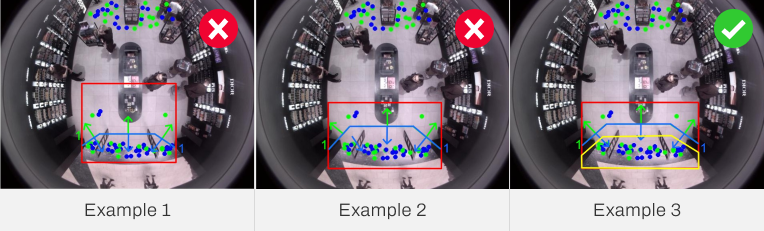
2. Counting Line Placement
Recommended image:
Two examples side-by-side: counting line in center vs counting line at image edge.
A counting line works by tracking a person:
- Before crossing the line
- During the crossing
- After crossing the line
If a person is only detected on one side, the crossing is incomplete and may not be counted.
Good practice
- Leave visible tracking space on both sides of the counting line
- Avoid placing the line at the boundary of camera coverage
3. Fisheye Camera Mounting (Top-Down)
Recommended image:
Ceiling-mounted fisheye above a doorway, with doorway inside the central circle.
For fisheye cameras:
- The central circular area provides the best tracking quality
- Tracking degrades gradually toward the outer edge
Good practice
- Align the doorway or walking path inside the central area
- Slightly off-centre mounting is acceptable if the counting line remains inside the core area
- Keep the camera level to avoid shifting usable coverage
4. Person Size in the Image
Recommended image:
Three people examples: too small, correct size, too large.
Tracking reliability depends on how large a person appears in the image.
- Too small → detection becomes unstable
- Too large → people overlap and block each other
Good practice
- Adjust mounting height and distance so full bodies are clearly visible
- Avoid placing the counting line too far from the camera (people too small)
- Avoid placing it too close (people too large)
5. Visual Blockage Check
Recommended image:
Camera view partially blocked by exit sign or hanging decoration.
People counting is a visual process. Any obstruction affects tracking.
Check for:
- Exit signs
- Hanging decorations
- Lighting fixtures
- Ceiling structures
Good practice
- Ensure the counting line and surrounding tracking area are fully visible
- Reposition the camera if any object blocks people near the line
6. Angled CCTV Camera Considerations
Recommended image:
Comparison of steep angle vs shallow horizontal CCTV view.
Angled cameras are more sensitive to positioning.
- More horizontal angles increase body overlap
- Occlusion increases as people block each other
- Tracking reliability drops faster than with top-down views
Good practice
- Use the steepest practical angle
- Avoid placing the counting line far from the camera
- Ensure people remain visible on both sides of the line
7. Maximising Coverage Without Reducing Accuracy
Recommended image:
Wide entrance covered by a single fisheye with clear central tracking zone.
When covering a wide area:
- Prioritise usable tracking space over total visible area
- Ensure the full walking path crosses the counting line within reliable coverage
Key point
A wider view is useful only if people can be tracked before and after the line crossing.
8. Final Installation Checklist
Before finalising installation, confirm:
- Counting line is inside the usable tracking area
- People are visible on both sides of the line
- Person size is appropriate (not too small or too large)
- No overhead or foreground blockage
- Camera angle minimises occlusion
If these conditions are met, tracking accuracy will be stable.